
Apple Enters the Foldable Era: The $1,999 ‘iPhone Duo’ Reshapes the Luxury Smartphone Market
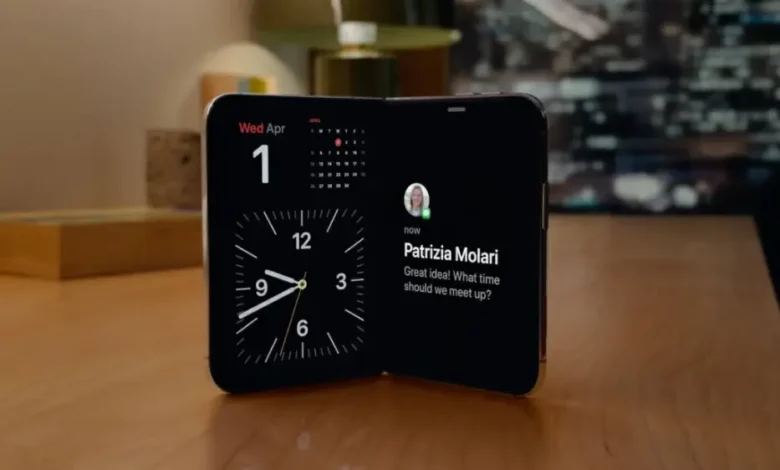
Apple has officially ushered in the era of foldable smartphones, unveiling the highly anticipated “iPhone Duo” during its annual keynote. Marking the first foldable device in the company’s history, the groundbreaking handset was introduced alongside a sweeping hardware lineup that includes the iPhone 18 Pro, iPhone 18 Pro Max, AirPods 5, and the new Apple Watch Series 12 and Ultra 4.
Representing the most significant architectural shift in Apple’s design language since the iPhone X, the iPhone Duo seamlessly bridges the gap between a traditional smartphone and a sprawling digital canvas. The premium device starts at $1,999 for the 256GB base model, with configurations extending up to a massive 2TB of storage. Pre-orders are set to go live on October 16, with the device hitting global markets on October 23.


The iPhone Duo: Engineering a New Standard
Encased in a sleek titanium chassis, Apple claims the iPhone Duo becomes the thinnest iPhone ever created when fully unfolded. The interior boasts a stunning 7.6-inch Super Retina XDR display, offering 50% more screen real estate than the iPhone 18 Pro Max and 80% more than the iPhone 18 Pro. On the outside, a 5.4-inch cover display delivers roughly 90% of the standard iPhone 18 Pro’s screen area, ensuring full functionality even when snapped shut.
The operating system has been heavily optimized for the new form factor. The software intelligently adapts to how the device is held, folded, or rotated, allowing users to prop it at any angle. Multitasking receives a massive upgrade, enabling users to run two distinct apps side-by-side or even open two instances of the same application simultaneously. Further blurring the line between phone and tablet, the iPhone Duo will support the Apple Pencil on both displays via a software update slated for later this year.
To achieve this, Apple engineered a highly complex multi-layered display system. The architecture relies on carbon fiber support panels, a robust titanium frame, and a meticulous hinge mechanism comprising over 100 microscopic components to guarantee extreme durability and a perfectly flat inner screen.
Available in “Star White” and “Night Sky,” the device features a Touch ID sensor integrated into the side button, Apple Watch unlocking capabilities, and an IP68 rating for water and dust resistance. Battery life is equally impressive: users can expect up to 24 hours of mixed, equal usage across both screens, 31 hours of video playback on the main inner screen, and up to 44 hours on the outer display. Fast charging capabilities can replenish the battery to 50% in just 20 minutes.
Unprecedented Camera Flexibility
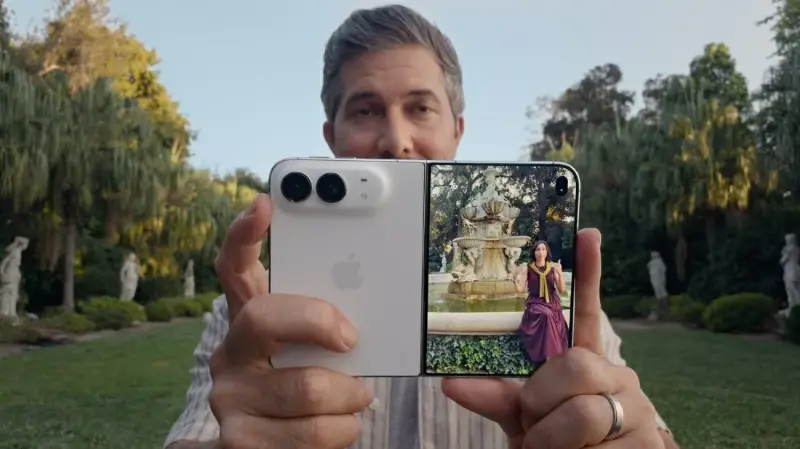
The iPhone Duo leverages its unique folding geometry to rethink mobile photography. It features a formidable dual rear setup featuring a 48-megapixel Fusion camera and a 48-megapixel ultra-wide lens, backed by new computational photography modes. The hinge allows the phone to act as its own tripod, perfect for hands-free shooting and capturing 4K Dolby Vision HDR time-lapse videos.
For selfies and video calls, the device sports a 12-megapixel front-facing camera equipped with Center Stage, alongside a newly integrated interior FaceTime camera designed for use whether the phone is fully flat or partially folded. A novel “Dual Capture” feature allows creators to record from both the front and rear cameras simultaneously, while the outer screen serves as a high-resolution preview monitor for subjects during photoshoots.
A New Era of Leadership and a $2,000 Gamble
This monumental hardware event also marked the keynote debut of John Ternus as Apple’s new CEO, taking the helm from Tim Cook. Previously serving as the head of hardware engineering with a notoriously low-profile media presence, Ternus faces the immediate challenge of convincing consumers to embrace a $2,000 smartphone—setting a new benchmark for “mass luxury.”
While rivals like Samsung and Huawei have populated the foldable market since 2019, the category has largely remained a niche playground for tech enthusiasts. However, market analysts are exceptionally bullish on Apple’s entry. Research firms, including the International Data Corporation (IDC), project that Apple will effortlessly sell through its entire initial production run, ultimately capturing a dominant 40% share of the lucrative foldable segment by the end of next year.
iPhone 18 Pro & Pro Max: Doubling Down on AI
For traditionalists, Apple introduced the iPhone 18 Pro (starting at $1,199 for 256GB) and the iPhone 18 Pro Max (starting at $1,299), with storage options scaling up to 2TB. Both flagship devices are powered by the bleeding-edge A20 Pro chip, built on a revolutionary 2-nanometer process. Its new 7-core GPU delivers a staggering 40% leap in graphics performance.
Artificial Intelligence is the true star of the 18 series. Apple has dramatically overhauled Siri, granting the voice assistant deep personal context awareness. Siri can now parse information across emails and messages to execute complex commands, even across third-party applications outside the immediate Apple ecosystem. Crucially, Apple emphasized that these AI operations rely heavily on on-device processing and “Private Cloud Compute” to ensure airtight data privacy.
The iPhone 18 Pro line also introduces a groundbreaking 48-megapixel Fusion main camera featuring a variable aperture. This mechanical lens can physically open wider in low-light environments, drawing in 50% more light while offering pro-level manual controls over white balance, shutter speed, and depth of field. In a direct response to the era of deepfakes, Apple unveiled the “Apple Reference Image” feature, which cryptographically signs photo metadata at the exact moment of capture to authenticate real, human-taken imagery against AI-generated content.
AirPods 5 and the AI-Powered Apple Watch
Expanding the wearable ecosystem, the new AirPods 5 adopt an open-ear design while introducing Active Noise Cancellation (ANC), advanced audio intelligence, and seamless “Live Translation” capabilities. The base model is priced at $129, while a $149 premium tier adds stem-based volume controls and wireless charging.
Health and longevity dominate the narrative for the new Apple Watch Series 12 ($399) and Apple Watch Ultra 4 ($799). The revamped biometric sensors now read heart rates every 5 seconds—60 times faster than prior generations—and track Heart Rate Variability (HRV) every 5 minutes.
A new “Health Age” metric cross-references user data like sleep quality, VO2 Max, and integrated blood test results against their chronological age, housed within a dedicated “Longevity” tab. A daily “Readiness” score also evaluates vitals and prior exertion to advise users on how hard they should train that day. For extreme users, the Ultra 4 delivers up to two days of standard battery life, 18 hours of continuous GPS/heart rate tracking, and 45 hours in extended workout mode.
Apple has also infused the Apple Watch with “Audio Intelligence.” The device’s microphones can now contextually identify critical environmental sounds, such as alarms, doorbells, or a crying baby. A new “Live Rewind” function allows users to jump back 15 seconds to view a transcription of recently spoken words, while “Siri Recap” can transcribe, summarize, and generate bullet points for business meetings or parent-teacher conferences—all without storing any permanent audio recordings.
With John Ternus steering the ship, the launch of the iPhone Duo and the heavy integration of on-device AI signify a bold new chapter for Apple. By pushing the boundaries of price and form factor, the tech giant is making a calculated bet that it can redefine luxury tech and turn the foldable phone from a niche curiosity into an essential pillar of the global digital economy.
Apple, iPhone Duo, foldable smartphones, Apple stock, tech news, John Ternus, iPhone 18 Pro, AI technology, financial markets, luxury tech, Apple Watch Series 12, investing